Embark on a 3-night cruise from Aswan to Luxor and experience the highlights of Upper Egypt. Explore ancient temples, visit the Valley of the Kings, and take a hot air balloon ride. Enjoy delicious meals on board a 5-star ship and immerse yourself in the rich Egyptian culture. Book now for the best price and quality service!
Embark on a 3-night cruise from Aswan to Luxor and experience the highlights of Upper Egypt. Explore ancient temples, visit the Valley of the Kings, and take a hot air balloon ride. Enjoy delicious meals on board a 5-star ship and immerse yourself in the rich Egyptian culture. Book now for the best price and quality service!
Aswan: A Charming City Celebrated for Nubian Culture - Visit the Temple of Philae & Aswan High Dam
Temple of Philae - Arrive in Aswan, a beautiful city renowned for its Nubian culture. Begin the first tour by heading down to the Nile, where a motorboat will take you to the magnificent Philae Temple. Continue to the impressive Aswan High Dam. In…
Aswan: A Charming City Celebrated for Nubian Culture - Visit the Temple of Philae & Aswan High Dam
Temple of Philae - Arrive in Aswan, a beautiful city renowned for its Nubian culture. Begin the first tour by heading down to the Nile, where a motorboat will take you to the magnificent Philae Temple. Continue to the impressive Aswan High Dam. In the evening, enjoy the opportunity to explore Aswan’s famous local market. Check in to the Nile cruise for an overnight stay.
Aswan High Dam - The Aswan High Dam, also known as the High Dam, is a significant water dam on the Nile in southern Egypt. Constructed during the era of Gamal Abdel Nasser with Soviet assistance, the dam plays a crucial role in controlling water flow and reducing the impact of the Nile flood. It also generates electricity for Egypt. The dam measures 3,600 meters in length, with a base width of 980 meters, a summit width of 40 meters, and a height of 111 meters. It comprises 43 million cubic meters of cement, iron, and other materials. The dam can handle a water flow of 11,000 cubic meters per second. Construction began in 1960, with a total cost of one billion dollars, one-third of which was covered by the Soviet Union. The dam was completed in 1968 with the help of 400 Soviet experts, and the final 12 electric generators were installed in 1970. It was officially inaugurated in 1971.
Abu Simbel Temples & Temple of Kom Ombo & Sailing to Edfu
Abu Simbel Temple Complex - Construction of the temple complex began around 1244 BC and lasted approximately 21 years, until 1223 BC. Known as the “Ramses Temple,” it is one of six rock temples in Nubia erected during the reign of Ramses II. Its purpose was to influence neighboring countries in southern Egypt and to strengthen the Egyptian religion’s presence in the region. Historians suggest that Abu Simbel’s design reflects Ramses II’s pride. The temples were abandoned over time and became buried in sand. By the 6th century BC, sand covered the main temple’s statues up to their knees. The temple was forgotten until 1813 when Swiss orientalist GL Burkhardt discovered the main temple’s promenade. Burkhardt shared this discovery with an Italian explorer.
Temple of Kom Ombo - Established during the reign of Ptolemy VI Philomator, the temple’s decoration was completed in the Roman era under Emperor Tiberius. This temple shares design, architecture, and decoration characteristics with other Egyptian Ptolemaic temples. However, it has a unique feature due to local worship practices, where two local deities, Sobek and Horus-headed, were worshipped. Despite their differing origins and characters, they coexisted for centuries without merging, resulting in two separate sanctuaries within the temple.
Temple of Edfu & Sailing to Luxor
Temple of Horus - Around 5:00 am, be ready to visit the ancient city known as Geb by the Egyptians and Apollinopolis Magna by the Greeks and Romans. Edfu was the capital of the second region in Upper Egypt during the Pharaohs’ era. Archaeological excavations since the late 19th century have highlighted its significance in early ancient Egyptian history, particularly the cemetery dating back to the Old Kingdom in the third millennium BC. Linguists have deciphered the name of one of the first dynasty kings, Oujib, engraved on a rock near the city. Edfu was under the protection of the falcon deity Horus, the city’s king.
Hot Air Balloon & Valley of the Kings & Temple of Hatshepsut & Colossi of Memnon & Temple of Karnak
Hot Air Balloon Luxor Take Off Site - The adventure typically begins before dawn with a hot air balloon ride over the West Bank. As the sun rises, painting the sky with shades of orange and pink, you’ll ascend into the peaceful morning air. From this unique perspective, Luxor’s landscape unfolds beneath you. The lush green Nile contrasts with the vast ochre desert. Ancient temples and tombs, still shrouded in morning mist, appear as miniature models. The Valley of the Kings’ winding paths, Hatshepsut’s Temple’s imposing silhouette, and the Colossi of Memnon’s solitary figures become part of a grand tapestry, offering a perspective impossible to grasp from the ground. This serene and awe-inspiring experience provides a profound sense of the scale and timelessness of this ancient civilization, creating lasting memories.
Valley of the Kings - Also known as the “Valley of Biban Kings,” this valley in Egypt was used for 500 years between the 16th and 11th centuries BC. Located on the west bank of the Nile, opposite Thebes (now Luxor), it is part of the ancient funerary city of Thebes. The Valley of the Kings is divided into two valleys, with most royal tombs in the Eastern Valley.
Temple of Hatshepsut at Deir el Bahari - This temple from the 18th Egyptian dynasty is one of the best-preserved temples, built about 3,500 years ago in Deir el-Bahari, Egypt. Constructed by Queen Hatshepsut on the west bank of the Nile opposite Taiba (ancient Egypt’s capital and Amun’s worship center, now Luxor), the temple is distinguished by its unique architectural design compared to other Egyptian temples on the Nile’s east bank in Thebes. It consists of three successive floors on open terraces, built of limestone. In front of the second floor’s pillars, limestone statues of the god Osiris and Queen Hatshepsut were beautifully arranged and originally colored.
Colossi of Memnon - These two colossal statues, erected around 1350 BC, are all that remains of a temple commemorating Pharaoh Amenhotep III, located in Thebes, Western Egypt. They represent King Amenhotep III, a ruler from the powerful 18th Dynasty in ancient Egyptian history. The statues stand 19 meters tall, and the Greeks named them “Memnon” after the eastern statue cracked and emitted a sound reminiscent of the legendary hero Memnon, who was killed in battle and called to his mother, the goddess of dawn, every morning. Her tears were said to be dew.
Temple of Karnak - The Karnak Temple Complex, known as the Karnak Temple, is a collection of temples, buildings, and columns, with construction and expansion continuing from the Pharaonic era, specifically the Middle Kingdom kings, to the Roman era in Luxor, Egypt, on the eastern bank. The temple was dedicated to the divine Trinity Amun (Amun Ra in modern times), his wife, the goddess Mut, and their son, the god Khonsu. Each has a temple within the Karnak complex. Tourists and non-specialists often refer to the temple dedicated to Amun, Amun Ra. The temple’s name derives from the city of Karnak, a modern name distorted from the Arabic word “Khorang,” meaning the fortified village, which was applied to many temples in the region during this period.
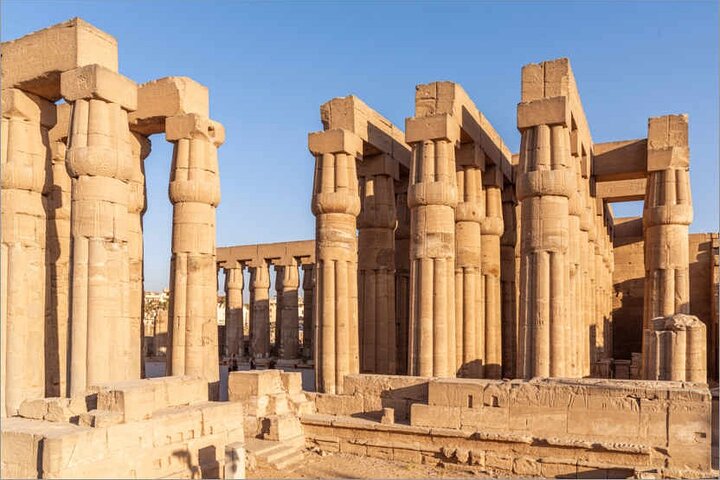
Luxor Temple - The Luxor Temple is a large complex of ancient Egyptian temples located on the eastern bank of the Nile in Luxor, known as “ancient Thebes.” Founded in 1400 BC, the Luxor Temple was built for the worship of Amun Ra, his wife Mut, and their son Khonsu, collectively known as the Theban Triad. Constructed during the 18th and 19th Dynasties, the temple’s most significant structures were built by Amenhotep III (1397-1360 BC) and Ramses II (1290-1223 BC), who added the open courtyard, pylon, and two obelisks. King Tuthmosis III (1490-1436 BC) also contributed to the temple’s construction.

- Meals start with lunch first day end with breakfast last day.
- 3-nights on cruise board
- Cabin with all facilities.
- All sites which mentioned in itinerary.
- Air-conditioned vehicle
- Hot air balloon.
- Lunch
- Dinner
- Horse and carriage.
- Breakfast
- Qualified Egyptology guide
- Hotel/port pickup and drop-off
- Meals start with lunch first day end with breakfast last day.
- 3-nights on cruise board
- Cabin with all facilities.
- All sites which mentioned in itinerary.
- Air-conditioned vehicle
- Hot air balloon.
- Lunch
- Dinner
- Horse and carriage.
- Breakfast
- Qualified Egyptology guide
- Hotel/port pickup and drop-off
- Gratuities(optional)
- Entrance fees
- Gratuities(optional)
- Entrance fees
Delight in the wonders of Aswan and Luxor, including visits to Kom Ombo and Edfu.
Explore the Valley of the Kings and much more with the expertise of an Egyptology guide.
Savor buffet-style breakfasts, lunches, and dinners aboard a luxurious 5-star ship.
Enjoy the convenience of door-to-door transfers to and from the port.
Embark on a…
Delight in the wonders of Aswan and Luxor, including visits to Kom Ombo and Edfu.
Explore the Valley of the Kings and much more with the expertise of an Egyptology guide.
Savor buffet-style breakfasts, lunches, and dinners aboard a luxurious 5-star ship.
Enjoy the convenience of door-to-door transfers to and from the port.
Embark on a once-in-a-lifetime hot air balloon adventure.
Discover the magnificent temples of Abu Simbel.
Immerse yourself in the authentic Egyptian culture of Luxor and Aswan.
Experience the most significant sites in Upper Egypt in one comprehensive package.
Our goal is to offer the best price and quality service.
Combine the serene beauty of the Egyptian Nile River cruise with the awe-inspiring temples and tombs of Upper Egypt.
- Other languages are available with extra charge upon your request.
- A child from 5 to 11 accompanied by one adult will be treated as an adult.
- Children from 5 to 11 sharing with parents .(maximum 2 children in one room).
- If your arrival to Aswan is so early, so we will start the tour direct upon arrival as Cruise check in at 12:00.
- Prices are quoted in U.S dollars,per person per trip and valid,except during Christmas,New Year,Easter holidays.
- If the trip to Abu Simbel cancelled due to bad weather, you will be refunded with 25USD per person, and 12.5 $USD per child. .
- If the Hot Air Balloon trip cancelled due to bad weather, you will be refunded with 25 USD per person, and 12.5 $USD per child. .
- Camera is not allowed on the balloon basket, you can only use your cellphone to take pictures.
- A child less than 6 years is not allowed for the balloon trip.
- If you want to have your own room, then you need to book for a single person.
- If you are traveling in a group of 3 people, you will enjoy one triple room.
- If you are traveling in a group and wanted to have your own room, then do a separate booking for a single person
- You will need to pay all the entrance fees by card except the High Dam and motorboat to Philae temple in cash.
- Our drop off location in Luxor after the tour on the last day can be at Luxor Airport, train or hotels in Luxor east bank
- The tour ends on the last day in Luxor city around 4 to 5 pm, so evening departure is recommended
For a full refund, cancel at least 24 hours before the scheduled departure time.
For a full refund, cancel at least 24 hours before the scheduled departure time.