

Experience the best of modern and traditional Japan on a full-day private trip to Yokohama and Kamakura. Explore these dynamic and ancient cities with a licensed guide!
Experience the best of modern and traditional Japan on a full-day private trip to Yokohama and Kamakura. Explore these dynamic and ancient cities with a licensed guide!
- Tsurugaoka Hachimangu Shrine - This shrine is dedicated to Hachiman, the patron deity of the Minamoto family and samurai in general. The deified spirits of the ancient Emperor Ojin, identified with Hachiman, Hime-gami, and Empress Jingu, are enshrined here.
- Kotoku-in (Great Buddha of Kamakura) - The Great Buddha of Kamakura (鎌倉大仏, Kamakura…
- Tsurugaoka Hachimangu Shrine - This shrine is dedicated to Hachiman, the patron deity of the Minamoto family and samurai in general. The deified spirits of the ancient Emperor Ojin, identified with Hachiman, Hime-gami, and Empress Jingu, are enshrined here.
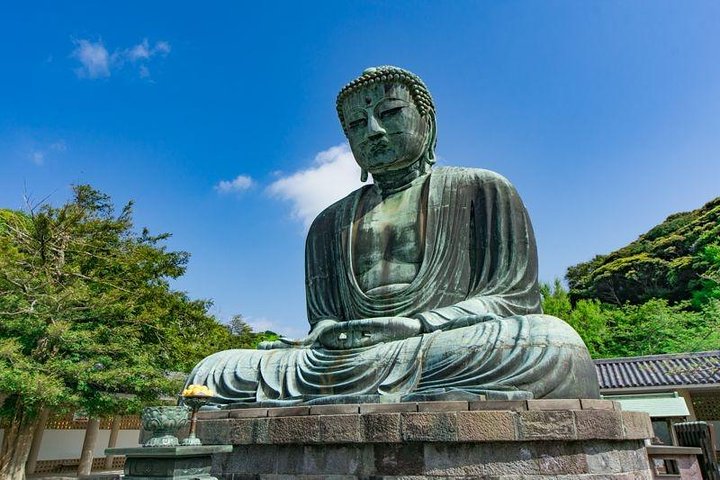
- Kotoku-in (Great Buddha of Kamakura) - The Great Buddha of Kamakura (鎌倉大仏, Kamakura Daibutsu) is a bronze statue of Amida Buddha located at Kotokuin Temple. Standing at 11.4 meters, it is the second tallest bronze Buddha statue in Japan, surpassed only by the statue in Nara’s Todaiji Temple and some newer creations.
- Hase-dera Temple - Hasedera (長谷寺) is a Jodo sect temple, renowned for its eleven-headed statue of Kannon, the goddess of mercy. The 9.18-meter-tall, gilded wooden statue is one of Japan’s largest wooden sculptures and can be admired in the temple’s main building, the Kannon-do Hall.
- Hokokuji Temple (Takedera Temple) - Hokokuji Temple is famous for its beautiful, small bamboo grove behind the main hall, featuring over 2000 dark green bamboo stalks. Narrow paths lead through the bamboo to a tea house where, for a small fee, visitors can enjoy a cup of matcha tea while taking in the bamboo grove views. Behind the temple are shallow caves believed to hold the ashes of some later Ashikaga lords.
- Enoshima Island - Just a short train ride west of Kamakura, Enoshima (江の島) is a charming tourist island off the coast, connected by a bridge to the mainland. The island offers various attractions, including a shrine, park, observation tower, and caves. On clear days, Mount Fuji can be seen.
Enoshima is divided into a yacht harbor accessible to motorized traffic and a forested hill, which can only be explored on foot (and paid escalators) and contains most of the sights. Several shrine buildings, collectively known as Enoshima Shrine, are dedicated to Benten, a popular goddess of good fortune, wealth, music, and knowledge. Benten is believed to have created Enoshima before subduing a five-headed dragon that terrorized the area.
- Engaku-ji Temple - Engakuji (円覚寺) is one of the leading Zen temples in Eastern Japan and ranks second among Kamakura’s five great Zen temples. Founded by the ruling regent Hojo Tokimune in 1282, one year after the second Mongol invasion attempt was repelled, the temple was established to honor the fallen Japanese and Mongolian soldiers.
Engakuji is nestled into the slopes of Kita-Kamakura’s forested hills. The first main structure encountered upon entering the temple grounds is the Sanmon main gate, dating from 1783. Behind it stands the temple’s main hall, the Butsuden, which houses a wooden statue of the Shaka Buddha. The Butsuden was rebuilt in 1964 after the previous building was lost in an earthquake.
- Kencho-ji Temple - Kenchoji (建長寺, Kenchōji) is the foremost of Kamakura’s five great Zen temples. The oldest Zen temple in Kamakura, Kenchoji was founded by the ruling regent Hojo Tokiyori in 1253 during the Kencho Era, after which it was named. Its first head priest was Rankei Doryu, a Zen priest from China.
Although smaller than during its peak, Kenchoji still comprises numerous temple buildings and subtemples, stretching from the entrance gate at the valley’s bottom far into the forested hills behind. After passing through the Sanmon main gate, visitors will see Kenchoji’s temple bell (Bonsho), designated a national treasure, on their right.
- Zeniarai Benten Shrine - Zeniarai Benten Shrine (銭洗弁天) is a popular shrine in western Kamakura, where people visit to wash their money (zeniarai means “coin washing”). It is said that money washed in the shrine’s spring will double.
Minamoto Yoritomo, the founder of the Kamakura government, ordered the shrine’s construction after a god appeared in his dream and advised him to build the shrine to bring peace to the country. Since the dream occurred on the day of the snake, in the month of the snake of the year of the snake, the shrine was later also dedicated to Benten, a Buddhist goddess associated with snakes.
- Meigetsuin (Hydrangea Temple) - Meigetsuin Temple (明月院) is a temple of the Rinzai Zen Sect founded in 1160 in Kamakura. It is also known as Ajisaidera (“Hydrangea Temple”) because hydrangeas bloom abundantly on the temple grounds during the rainy season around June. 95% of the hydrangeas here are of the Hime Ajisai (“Princess Hydrangea”) variety, named for their pretty blue colors.
The temple was originally a repose built by a son in memory of his father, who died in the power struggle between the Taira and Minamoto clans in the late Heian Period. It later became part of a larger temple complex called Zenkoji, which was abolished during anti-Buddhist movements soon after the Meiji Restoration, leaving only Meigetsuin as an individual temple today.
- Ankokuronji Temple - Ankokuronji (安国論寺) is one of several temples of the Nichiren sect of Japanese Buddhism along the hills in the southeast of Kamakura. Nichiren himself founded Ankokuronji around 1253 when he first came to Kamakura, and he is said to have lived at the temple for several years.
Visitors can walk along a short hiking trail through the wooded hills around the temple buildings. A nice view of the city of Kamakura can be enjoyed along the way. Some of the trail’s passages are quite steep and should only be explored with good walking shoes and during dry weather.
- Jomyo-ji Temple - Jomyoji Temple (浄妙寺, Jōmyōji) is a Zen temple in the hills of eastern Kamakura. Ranked fifth among the five great Zen temples of Kamakura, Jomyoji was founded by the influential Ashikaga family and at its peak consisted of seven buildings and several pagodas. Over the centuries, however, many structures were destroyed by fire, and only its historic main hall, reception hall, main gate, and warehouse remain today. The main hall sits at the end of a garden and houses a statue of Shaka Nyorai, the historical Buddha.
Jomyoji Temple also has a restored teahouse where visitors can enjoy a cup of tea for a small fee while enjoying the view of a lovely dry garden. On the hillside behind the main hall is the temple’s spacious cemetery, while a path leads up the hill to a small western-style restaurant. The restaurant is operated by the temple and offers good views over Kamakura from its patio.
- Zuisenji - Zuisenji (瑞泉寺) is a beautiful Zen temple in the far east of Kamakura, nestled in a narrow valley and surrounded by wooded hills. It is a branch temple of the Engakuji Temple.
Zuisenji was founded by Muso Kokushi, a leading Zen master of his time and one of Japan’s most famous garden designers. The temple is known for its pure Zen rock garden behind the main hall, designed by Muso himself. The temple also attracts visitors with its many flowers and blooming trees in other parts of the temple grounds, including a large number of plum trees.
- Myohonji Temple - Myohonji (妙本寺, Myōhonji) is one of several temples of the Nichiren sect of Japanese Buddhism along the southeastern hills of Kamakura. The temple was founded by Hiki Yoshimoto in 1260 and features a statue of Nichiren to the left of the main hall.
The temple is connected via the Gionyama hiking trail with some other nearby temples and a shrine. It leads through the wooded hills of Kamakura and should be explored only with good walking shoes and during dry weather, as there are a few steep and rough passages.
- Jochiji Temple - Jochiji (浄智寺, Jōchiji) is the fourth of Kamakura’s five great Zen temples. It is a branch temple of the Engakuji school of the Rinzai sect of Zen Buddhism. Its head temple, the Engakuji Temple, stands just a few hundred meters away on the opposite side of the railway tracks.
Jochiji was founded in 1283 by members of the ruling Hojo family on the occasion of the premature death of a son. Once a large temple complex with many buildings and subtemples, Jochiji is now small and calm. In its main hall, the Dongeden, the temple’s main object of worship, a Buddhist trinity of the Amida Buddha, Shaka Buddha, and Miroku Buddha, is displayed.
- Tokeiji Temple - Tokeiji (東慶寺, Tōkeiji) is a small branch temple of the Engakuji school within the Rinzai sect of Zen Buddhism. Its head temple, the Engakuji Temple, stands just a few hundred meters away on the opposite side of the railway tracks.
Tokeiji was founded by the wife of the regent Hojo Tokimune in 1285 after Tokimune had died at a young age. Until the end of the Edo Period, the temple served as a shelter for women who suffered abuse by their husbands and sought a divorce. An official divorce could be attained by staying at the temple for three years.
- Jufukuji Temple - Jufukuji Temple (寿福寺) is the third of Kamakura’s five great Zen temples. It is a branch temple of the Rinzai sect’s Kenchoji school.
Jufukuji was established by the order of Minamoto Yoritomo’s wife Masako after her husband had passed away. Its founding priest was none other than Eisai, the man responsible for introducing Zen Buddhism into Japan. Besides the often-photographed pathway that leads towards the temple, Jufukuji is not open to the public.
- Eishoji Temple - Eisho-ji Temple (英勝寺) is the only surviving nunnery in Kamakura, located near Tsurugaoka Hachimangu. Founded in the early Edo period by a woman connected to the Tokugawa family, it’s known as a “flower temple” for its seasonal blooms.
Visitors can enjoy a peaceful bamboo grove and a graceful Amida Buddha statue said to be by the famous sculptor Unkei. The quiet atmosphere makes it a hidden gem worth visiting.
- Sankeien Gardens - Sankeien (三溪園) is a spacious Japanese-style garden in southern Yokohama, showcasing a number of historic buildings from across Japan. There is a pond, small rivers, flowers, and wonderful strolling trails that make you feel like you are in Kyoto rather than Yokohama.
The garden was built by Hara Sankei and opened to the public in 1904. Among the historic buildings exhibited in the park are an elegant daimyo (feudal lord) residence, several tea houses, and the main hall and three-storied pagoda of Kyoto’s old Tomyoji Temple.
- Yokohama Chinatown - Yokohama Chinatown (横浜中華街, Yokohama Chūkagai) is Japan’s largest Chinatown, located in central Yokohama. A large number of Chinese stores and restaurants can be found in the narrow and colorful streets of Chinatown. Various events and festivals, such as Chinese New Year around the beginning of February, are also held in Chinatown.
Yokohama Chinatown quickly developed after the port of Yokohama was one of the first Japanese ports to open to foreign trade in 1859. It became the residence of many Chinese traders who settled in the city. Today, there are more businesses than actual residents living in the area.
Four colorful gates stand at the entrances to Chinatown, and five more gates can be found within. The Kanteibyo is a gaudily colored temple in the center of Chinatown. Constructed in 1873 by Chinese residents, it is dedicated to the Chinese god of good business and prosperity.
- Yokohama Minato Mirai 21 - Minato Mirai 21 (みなとみらい 21) is a seaside urban area in central Yokohama, whose name means “harbor of the future.” It features many large high-rises, including the Landmark Tower, which was Japan’s tallest building from 1993 until 2014. The area was a large shipyard until the 1980s when development began to transform it into a new city center.
Minato Mirai boasts a great location along the water and offers a wealth of attractions. Visitors to the area will find shopping centers, hotels, a convention center, an amusement park, a relaxation center with hot spring baths, museums, and park space.
- Motomachi Park - For most of the 250 years of the Edo Period (1603-1867), the rulers of Japan prohibited almost all interactions with foreign countries. When the period of isolation finally ended in the 1850s, Yokohama was one of only a few port towns where foreign traders, looking to profit from the newly opened country, were permitted to reside. While the Chinese established a Chinatown, Westerners settled in the hills of the Yamate area, also known as “The Bluff.”
The Yamate area (山手) retains several sites relating to its history as the main residential district of Westerners in Yokohama. However, due to the Great Kanto Earthquake, few of them predate 1923. Present-day Yamate is still largely a hilly residential area with some pleasant parks. As visitors travel between Yamate’s sightseeing spots, they will notice the international schools and churches that indicate the continued presence of Western residents.
- Yamate 234ban Residence - For most of the 250 years of the Edo Period (1603-1867), the rulers of Japan prohibited almost all interactions with foreign countries. When the period of isolation finally ended in the 1850s, Yokohama was one of only a few port towns where foreign traders, looking to profit from the newly opened country, were permitted to reside. While the Chinese established a Chinatown, Westerners settled in the hills of the Yamate area, also known as “The Bluff.”
The Yamate area (山手) retains several sites relating to its history as the main residential district of Westerners in Yokohama. However, due to the Great Kanto Earthquake, few of them predate 1923. Present-day Yamate is still largely a hilly residential area with some pleasant parks. As visitors travel between Yamate’s sightseeing spots, they will notice the international schools and churches that indicate the continued presence of Western residents.
- Cup Noodles Museum Yokohama - The Cup Noodles Museum (also known as the 安藤百福発明記念館, Andō Momofuku Hatsumei Kinenkan) is a fun and interactive museum in Yokohama’s Minato Mirai District that showcases the history of instant ramen noodles through whimsical exhibits and hands-on workshops. It was opened by the Nissin Food company, whose founder invented instant ramen noodles in 1958 as a fast and convenient food. It is the second cup noodles museum to open in Japan; the first is the Momofuku Ando Instant Ramen Museum in Osaka.
Tickets can only be purchased on the day. Visitors must line up before 10 am at the museum to purchase tickets.
- Yamashita Park - Yamashita Park (山下公園, Yamashita Kōen) is a public park that stretches about 750 meters along Yokohama’s waterfront. The park is about a hundred meters wide and consists mostly of open green space. It was constructed after the Great Kanto Earthquake of 1923.
Strolling through Yamashita Park, it is hard to miss the massive ocean liner in the water beside the promenade. The ship is called the Hikawa Maru and was first put into service in 1930 along the Yokohama-Vancouver/Seattle line. The ship had first-class cabins that attracted the likes of the imperial family and Charlie Chaplin for the transpacific journey. In 1960, after 30 years at sea, the ship was retired. It now serves as a museum, with informative displays and interiors in the style of the 1930s.
- Osanbashi Yokohama International Passenger Terminal - The Osanbashi International Passenger Terminal (大さん橋国際客船ターミナル, Ōsanbashi Kokusai Kyakusen Terminal), also known as Osanbashi Pier, is located between Minato Mirai and Yamashita Park. It is where international cruise ships dock when they visit Yokohama. The 400-meter pier has walkways and green spaces open to the general public, making Osanbashi Pier an interesting attraction even for travelers not boarding a ship.
The pier was originally built in 1894 but was reconstructed in 2002 as a passenger terminal. Its bold new design incorporates grass and floorboards that mimic rolling waves. The pier is one of Yokohama’s best spots for a walk and for unobstructed views of the Minato Mirai skyline. Below the walking area, there are boarding facilities, shops, restaurants, and a hall for small exhibitions and events.
- Shinyokohama Ramen Museum - The Shinyokohama Raumen Museum (新横浜ラーメン博物館, Shin Yokohama Ra-men Hakubutsukan) is a unique museum about ramen, a very popular Japanese noodle dish originally introduced from China.
In a gallery on the first floor, the Ramen Museum presents the history of ramen noodles in Japan, including the big success of instant ramen. It displays the variety of noodles, soups, toppings, and bowls used across Japan and shows how the noodles are made.
On the two basement floors, visitors can explore a 1:1 replica of some streets and houses of Shitamachi, the old town of Tokyo, around the year 1958, when the popularity of ramen was rapidly increasing. Nine ramen restaurants can be found there, each featuring a ramen dish from a different region of Japan.

- Meet up with guide on foot within designated area of Yokohama/Kamakura
- Customizable Tour of your choice of 3-4 sites from ‘Itinerary’ list
- Licensed Local English Speaking Guide
- Meet up with guide on foot within designated area of Yokohama/Kamakura
- Customizable Tour of your choice of 3-4 sites from ‘Itinerary’ list
- Licensed Local English Speaking Guide
- Transportation fees, Entrance fees, Lunch, and Other personal expenses
- Private transportation
- You cannot combine multiple tour groups.
- Guide Entry fees are only covered for sights listed under What to Expect.
- Transportation fees, Entrance fees, Lunch, and Other personal expenses
- Private transportation
- You cannot combine multiple tour groups.
- Guide Entry fees are only covered for sights listed under What to Expect.
Enjoy an efficient, one-day walking tour of Yokohama or Kamakura accompanied by a government-licensed and experienced English-speaking guide!
For options to experience both modern and traditional sides of Japan outside of Tokyo, the cities of Yokohama and Kamakura are great. Let us know which city you would like to experience and we will customize a…
Enjoy an efficient, one-day walking tour of Yokohama or Kamakura accompanied by a government-licensed and experienced English-speaking guide!
For options to experience both modern and traditional sides of Japan outside of Tokyo, the cities of Yokohama and Kamakura are great. Let us know which city you would like to experience and we will customize a six-hour tour that’s best for you!
Note1: You cannot visit all the sites on the itinerary. You will be able to visit about 3 sites, with a maximum of 4, in the time provided.
Note2: The National Government Licensed Guide Interpreter certification is issued by the Japanese government requires a good knowledge and understanding of Japanese culture and history.
- Travel time between Yokohama and Kamakura is about 30 minutes one way.
- This is a walking tour. Pick up is on foot.
For a full refund, cancel at least 24 hours before the scheduled departure time.
For a full refund, cancel at least 24 hours before the scheduled departure time.