Uncover the captivating history of Vlad III, also known as Dracula, through a journey to Dracula’s Tomb and Mogosoaia Palace. Explore his origins, his battles, and his legacy.
Uncover the captivating history of Vlad III, also known as Dracula, through a journey to Dracula’s Tomb and Mogosoaia Palace. Explore his origins, his battles, and his legacy.
- Snagov Monastery - Nestled within the woods and encircled by the waters of Lake Snagov, the Snagov Monastery was a pivotal spiritual and cultural hub of Wallachia during the feudal era. Constructed on an ancient site, archaeological discoveries have unearthed Bronze Age and Iron Age clay pots, along with Roman and Byzantine coins, making it one of…
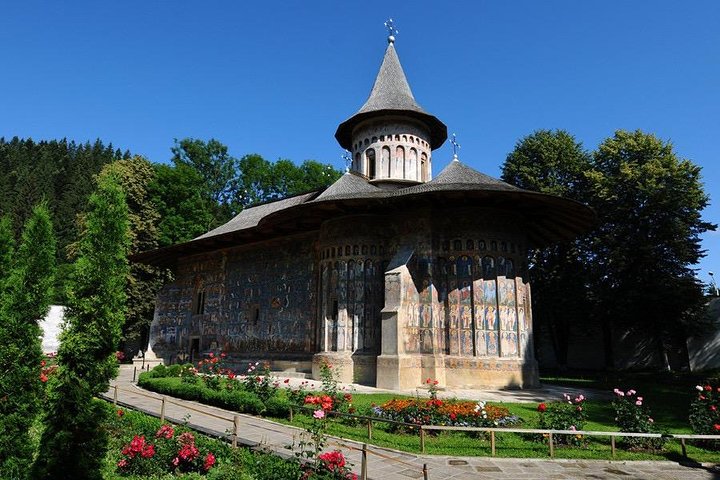
- Snagov Monastery - Nestled within the woods and encircled by the waters of Lake Snagov, the Snagov Monastery was a pivotal spiritual and cultural hub of Wallachia during the feudal era. Constructed on an ancient site, archaeological discoveries have unearthed Bronze Age and Iron Age clay pots, along with Roman and Byzantine coins, making it one of the oldest monastic establishments near Bucharest. According to some legends, after the ruler was assassinated in 1476 by Wallachian boyars in the Balteni forest, the monastery’s monks secretly buried his body in the church. Inside the monastery, a plaque indicates that beneath a stone slab, directly in front of the church altar, lies the grave of the great ruler.
- Mogosoaia Palace - Mogosoaia Palace stands as a significant historical edifice, symbolizing Romanian architecture. Situated approximately 15 kilometers from Bucharest’s center in Ilfov County, Mogosoaia Palace is a national treasure, listed among historical monuments. Built between 1698 and 1702 by Constantin Brancoveanu in the Romanian Renaissance or Brancovenesc style, it combines Venetian and Ottoman elements. The palace is named after the widow of the Romanian boyar Mogos, who owned the land where it was constructed. After 1714, when Constantin Brancoveanu and his family were executed in Constantinople, the Ottomans confiscated their wealth, and the palace was turned into an inn. It was reclaimed during Serban Cantacuzino’s reign and later returned to his nephew, Constantin Brancoveanu, until the early 19th century. The palace has endured many unfortunate events over time, being ravaged during the Russian-Turkish war from 1768 to 1774 and the 1821 revolution, when the last family descendant, Grigore Brancoveanu, sought refuge in Brasov, leaving the building occupied by revolutionaries.
- Snagov - Situated 25-30 km from Bucharest, covering an area of approximately 600 hectares and stretching 16 km in length, Lake Snagov is the most significant river edge on the lower Ialomița course. With a maximum depth of 9 meters, it is the deepest lake in the Romanian Plain. The lake’s shape is elongated and winding, featuring numerous bays. The downstream area includes the island hosting the Snagov Monastery. The region’s biodiversity comprises 4,200 species of flora and fauna, with around 1,200 species protected by law and 42 listed as endangered. The fish population, attracting many amateur anglers, is notable for its 16 species: bleak, rudd, roach, bream, carp, Crucian carp, Prussian carp, tench, two goby species, eel, European perch, pumpkinseed, pike, zander, and catfish. Sport fishing is permitted on Lake Snagov only outside the protected area, maintaining a minimum distance of 500 meters upstream and downstream from it.

- Entrance fees to Snagov Monastery included
- Enjoy a photo session
- Expert tour guide provided
- Transportation in a premium car
- Entrance fees to Snagov Monastery included
- Enjoy a photo session
- Expert tour guide provided
- Transportation in a premium car
Vlad III, the leader of Wallachia, is estimated to have been born between 1428 and 1431, likely in the Transylvanian town of Sighişaora. His paternal nickname, ‘Dracul’, translates to Dragon and was inspired by his father, Vlad II Dracul’s, involvement in the Order of the Dragon. This organization was a chivalric order that focused on defending…
Vlad III, the leader of Wallachia, is estimated to have been born between 1428 and 1431, likely in the Transylvanian town of Sighişaora. His paternal nickname, ‘Dracul’, translates to Dragon and was inspired by his father, Vlad II Dracul’s, involvement in the Order of the Dragon. This organization was a chivalric order that focused on defending Christianity in Eastern Europe against the Ottomans. As a result of this, Vlad III came to be known as Dracula or ‘son of the Dragon’. The specifics surrounding Vlad’s demise are unconfirmed, but it’s generally accepted that he died between October and December 1476 during a battle. His severed head was later presented as a war trophy in Constantinople. Vlad’s daughter Maria was taken to the court of Naples, a ruling family with ties to her own. She was adopted and subsequently wed a nobleman from Naples.
For a full refund, cancel at least 24 hours before the scheduled departure time.
For a full refund, cancel at least 24 hours before the scheduled departure time.